Adres engellemelerine karşı hazırlanan bahsegel bağlantıları kullanıcıların kesintisiz erişimini sağlıyor.
 Written By: Rajesh Neupane
Nepal Solo Restricted Area Permit 2026: The Honest Guide from Kathmandu
- What the March 2026 Nepal Solo Restricted Area Permit Rule Change Actually Says
- All 15 Restricted Zones — Permit Fees and Best Season
- What the Nepal Solo Restricted Area Permit 2026 Actually Costs — The Full Picture
- How to Apply for a Nepal Solo Restricted Area Permit 2026 — Five Steps from Kathmandu
- Which Zone Should You Choose for Your Nepal Solo Restricted Area Permit 2026?
- Frequently Asked Questions
- A Note from Our Team at Info Nepal Tours and Treks
Enquiry Form
Nepal solo restricted area permit 2026 rules changed in March — and if the headlines are the only thing you have read, you are missing half the story. Solo trekkers can now hold the permit independently. That is genuinely good news. But land in Kathmandu without understanding the specifics and you may find the Maitighar permit office a lot less welcoming than the brochure suggested.
We have been running restricted area treks out of Kathmandu for years, and when Nepal’s Department of Immigration quietly rewrote the two-person rule in March 2026, we read every line carefully. This guide gives you the complete picture — fees, zones, real costs, and the five steps that actually get your permit issued. No headlines. Just what you need to know.
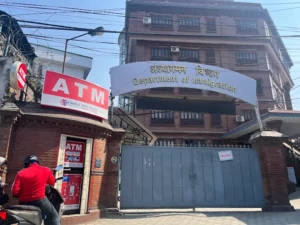
DOI Maitighar office, Kathmandu
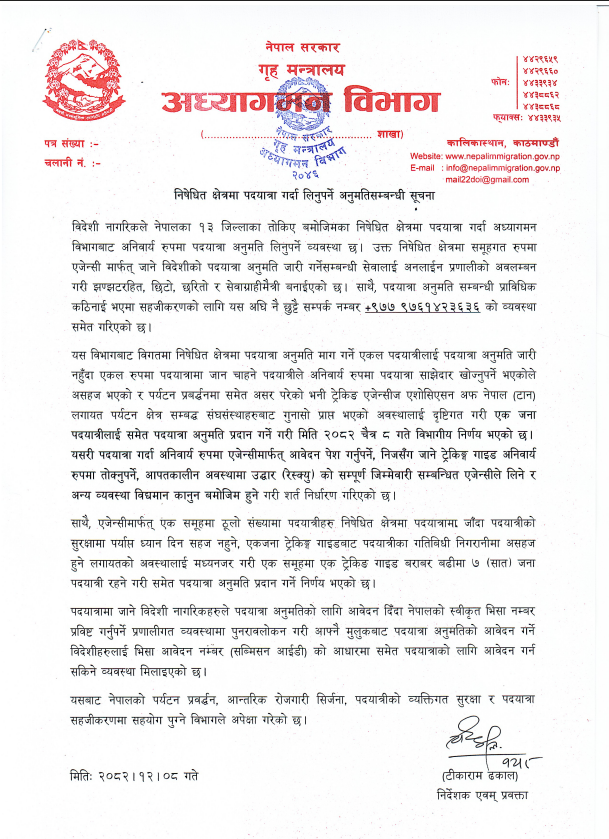
What the March 2026 Nepal Solo Restricted Area Permit Rule Change Actually Says
Before March 2026, every restricted area permit in Nepal required a minimum of two foreign trekkers on the application. No exceptions. A solo traveller — regardless of experience level or mountaineering background — could not hold the permit independently. That rule is gone.
One person. One permit. But here is what has not changed — and what you need to understand clearly before you book anything.
| What Changed | Before 2026 | From March 2026 |
| Minimum foreign trekkers | 2 required | 1 — solo now permitted |
| Licensed Nepali guide | Mandatory | Still mandatory |
| TAAN-registered agency | Mandatory | Still mandatory |
| Application method | In-person Kathmandu only | Online pre-application available |
| Maximum group size | No cap | 7 trekkers per group |
| Agency rescue responsibility | Recommended | Now legally mandated |
The point that catches most people off guard: “solo” refers to permit eligibility — not to unguided movement on the trail. A licensed guide walks with you. In zones where trails are unmarked, altitudes are serious, and the Tibet border runs nearby, that guide is not a formality. They are your most important piece of safety equipment.
All 15 Restricted Zones — Permit Fees and Best Season
The March 2026 update applies to 15 trekking zones across 13 districts, all bordering Tibet or India, all requiring a Nepal solo restricted area permit through a registered agency. One fee change worth flagging before you budget: Upper Mustang has moved from a flat USD 500 for 10 days to a USD 50 per-day rate. A 7-day trip now costs USD 350 — not USD 500. Solo trekkers benefit directly from this.
| Restricted Area | District | Permit Fee (Non-SAARC) | Best Season |
| Upper Mustang | Mustang | USD 50/day | March–November (monsoon-safe) |
| Upper Dolpo | Dolpa | USD 500 (first 10 days) + USD 50/extra day | June–October |
| Lower Dolpo | Dolpa | USD 20/week + USD 5/extra day | June–October |
| Manaslu Circuit | Gorkha | USD 100/week (Sep–Nov) · USD 75/week (other) | Mar–May, Sep–Nov |
| Tsum Valley | Gorkha | USD 40/week (Sep–Nov) · USD 30/week (other) | Mar–May, Sep–Nov |
| Nar & Phu Valley | Manang | USD 100/week (Sep–Nov) · USD 75/week (other) | Mar–May, Sep–Nov |
| Humla / Simikot | Humla | USD 50/week + USD 10/extra day | May–October |
| Kanchenjunga | Taplejung | USD 20/week (first 4 wks) · USD 25/week after | Mar–May, Oct–Nov |
| Makalu / Kimathanka | Sankhuwasabha | USD 20/week (first 4 wks) · USD 25/week after | Mar–May, Oct–Nov |
| Northern Khumbu | Solukhumbu | USD 20/week (first 4 wks) · USD 25/week after | Mar–May, Oct–Nov |
| Northern Langtang | Rasuwa | USD 20/week | Mar–May, Oct–Nov |
| Rolwaling Valley | Dolakha | USD 20/week | Mar–May, Oct–Nov |
| Bajhang | Bajhang | USD 90/week + USD 15/extra day | June–September |
| Mugu | Mugu | USD 100/week + USD 15/extra day | June–September |
| Darchula | Darchula | USD 90/week + USD 15/extra day | May–September |
What the Nepal Solo Restricted Area Permit 2026 Actually Costs — The Full Picture
This is the section most travel blogs skip. They quote the permit fee, mention the guide requirement in passing, and move on — and solo trekkers arrive in Kathmandu with a budget built for two. The permit fee rate is identical whether you are alone or in a group. What changes is that you carry the guide and agency costs entirely by yourself. Here is what a 10-day Upper Mustang solo trek honestly looks like:
| Cost Item | Two Trekkers (per person) | Solo Trekker |
| RAP Permit — 10 days | USD 500 | USD 500 |
| Licensed Guide — 10 days | USD 125 (split) | USD 250 (full) |
| Agency Service Fee | USD 150–300 (split) | USD 150–300 (full) |
| ACAP Conservation Fee | USD 30 | USD 30 |
| Helicopter Rescue Insurance | USD 80–150 | USD 80–150 |
| Estimated Total | USD 885–1,105 | USD 1,010–1,230 |
We are straightforward with our guests: going solo costs roughly USD 350–600 more than sharing costs with one companion. The guide’s daily rate — around USD 25–30 — is the main driver. Budget that in clearly before you commit. The mountains are patient.
How to Apply for a Nepal Solo Restricted Area Permit 2026 — Five Steps from Kathmandu
The application process is now partially digital — but it is not fully remote. Plan at least one full working day in Kathmandu. Do not try to land and head straight to the trailhead. Every season this catches someone out.
Step 1 — Choose a TAAN-Registered Kathmandu Agency
You cannot apply as a private individual. This is a hard rule. Ask for the agency’s TAAN registration number before you commit, and confirm your assigned guide holds the correct certification: Basic (up to 4,000m), Advanced (up to 5,500m), or Expedition (above 5,500m). Get it in writing.
Step 2 — Gather Your Documents
Before your agency can file anything, you will need:
- Passport with at least six months’ validity remaining
- Nepal visa details
- Two recent passport photographs
- Travel insurance certificate in English — must explicitly state helicopter medical evacuation coverage above 4,000m, minimum USD 100,000
- Confirmed trek itinerary
- Agency authorisation letter
Sort your insurance before you fly to Kathmandu — not the night before you leave for the mountains. It is checked at the permit stage, not assumed.
Step 3 — Online Pre-Application and Submission ID
Your agency submits through Nepal’s DOI portal. You receive a Submission ID you can track from anywhere in the world. The permit is not active at this point — do not mistake submission for approval.
Step 4 — Collect In Person at Maitighar DOI Office, Kathmandu
Department of Immigration, Maitighar, Kathmandu 44600. Open Sunday–Friday, 10:00–16:00 Nepal Standard Time. Closed Saturdays and public holidays. Payment in USD or NPR. Peak season processing: 2–4 hours. Off-season: sometimes 30 minutes. Read your permit carefully before you leave the building — your name, passport number, and permitted zone are all printed on it.
Allow a full business day buffer between collection and your departure for the trailhead. This is not optional advice.
Step 5 — Carry Physical Copies at All Times
Checkpoints use QR-code scanning, but connectivity near the Tibet border is unreliable. Screenshots are not accepted. Keep printed copies of your permit, your guide’s credentials, and your insurance certificate in your pack at all times.
Which Zone Should You Choose for Your Nepal Solo Restricted Area Permit 2026?
Spring is our personal favourite across most zones — April through early May, rhododendrons blazing against white peaks, views clean before afternoon cloud arrives. But the right zone depends on who you are and when you can travel.
| Zone | Who It Suits | Difficulty | Why It’s Worth Your Time |
| Upper Mustang | Culture-first travellers, anyone visiting June–Aug | Moderate | Lo Manthang’s walled city and cave monasteries. Stays dry through monsoon — rare in Nepal. |
| Manaslu Circuit | High-altitude trekkers wanting fewer crowds | Challenging | Larkya La at 5,106m. A fraction of the footfall on Annapurna or Everest circuits. |
| Nar & Phu Valley | Those who want genuine remoteness | Challenging | Tibetan villages that feel untouched. This detail alone is worth the permit. |
| Tsum Valley | Spiritual and cultural travellers | Moderate | Ancient Bon-Po monasteries and the sacred Beyul Kyimolung valley. Quiet and unhurried. |
Upper Mustang sits in a Himalayan rain shadow and remains dry through the monsoon months. If June, July, or August are your only windows, this is the route. No hesitation. For weather planning, DHM Nepal publishes mountain forecasts, and Windy.com is useful for real-time altitude wind checks before you depart.
Frequently Asked Questions
Can I actually trek alone in Nepal’s restricted areas in 2026?
Yes — the Nepal solo restricted area permit 2026 update means one person can now hold the permit independently. But unguided trekking is still not permitted. A licensed Nepali guide hired through a TAAN-registered agency is a legal requirement across all 15 zones. These are remote, high-altitude border regions. The guide is not a box-ticking formality — they are genuinely your most important safety resource on the trail.
Do permit fees increase for solo trekkers?
The permit fee rate is identical regardless of group size. What changes is that you absorb the guide’s daily rate and the agency service fee entirely alone — no partner to divide costs with. On a 10-day Upper Mustang trek, that works out to roughly USD 350–600 more than going with one companion.
How do I apply from abroad before arriving in Nepal?
Your TAAN-registered agency handles the online pre-submission through Nepal’s Department of Immigration portal. You will receive a Submission ID to track progress remotely. The permit is not issued until your agency presents your passport in person at the Maitighar DOI office. Plan at least one full working day in Kathmandu before you head for the trailhead.
What insurance is required?
Helicopter medical evacuation coverage above 4,000m, written in English, minimum USD 100,000. It is verified during the application — not assumed. The Himalayan Rescue Association has guidance on what valid policies look like for high-altitude Nepal trekking.
What happens if I trek outside my permitted zone?
Immediate permit cancellation and potential blacklisting from future restricted zone access. Enforcement near the Tibet border is consistent — not occasional spot checks. The consequences are not worth any detour, however tempting the trail looks.
Is there now a maximum group size under the 2026 rules?
Yes. The March 2026 update introduced a cap of seven trekkers per group across all restricted zones — a rule that did not previously exist. For most solo applicants this changes nothing in practice, but worth knowing if you are joining others on the same permit.
A Note from Our Team at Info Nepal Tours and Treks
We are Info Nepal Tours and Treks — a locally owned, Nepal Tourism Board-registered trekking company based in Kathmandu. We handle every step of the Nepal solo restricted area permit 2026 process on your behalf: TAAN submission, DOI collection, guide certification verification, insurance review, and a full checkpoint briefing before you leave the capital.
We are not the kind of company that tells you everything is straightforward and sends you a payment link. These are serious zones. The mountains near the Tibet border are unforgiving — and the experience of standing at Larkya La at dawn, or looking out over Lo Manthang from a monastery rooftop, is the kind of thing that quietly changes you. We want to get you there having understood exactly what you are walking into.
If you want to talk through your options before committing to anything, reach us at [email protected] or +977 9841936940. No pressure. Just an honest conversation with people who know these routes.