
Adres engellemelerine karşı hazırlanan bahsegel bağlantıları kullanıcıların kesintisiz erişimini sağlıyor.
 Written By: Rajesh Neupane
5 Things to Know Before Trekking to Everest Base Camp
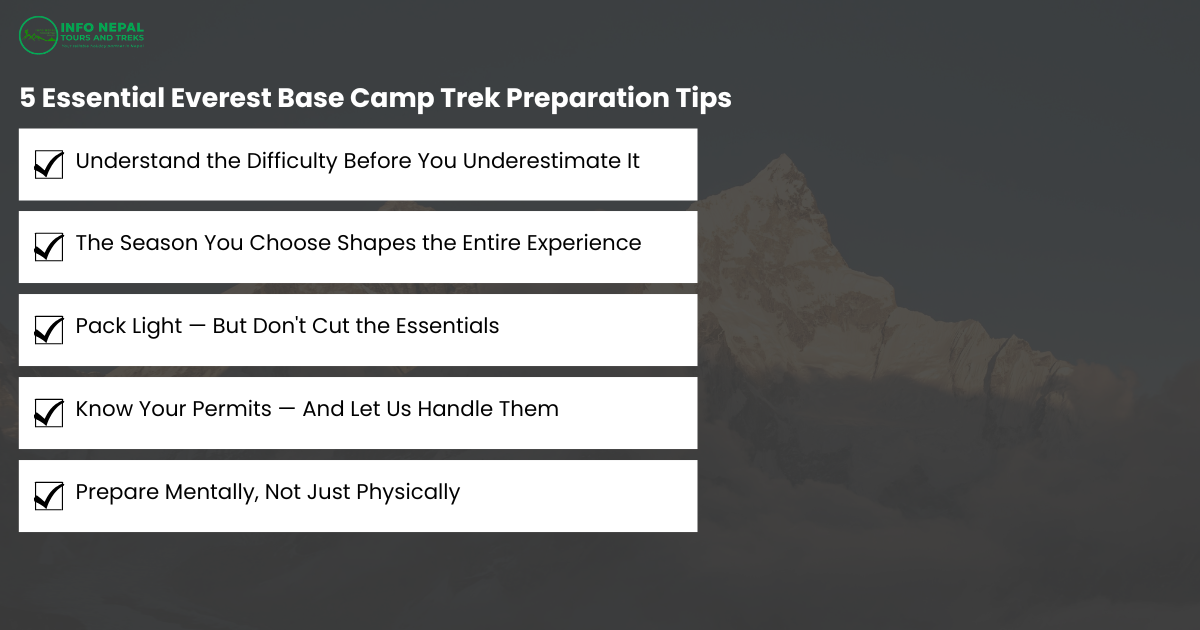
- 1. Everest Base Camp Trek Preparation Starts With Understanding the Difficulty
- 2. Season Selection Is a Core Part of Everest Base Camp Trek Preparation
- 🎒 3.3. Your Packing List Is Non-Negotiable Everest Base Camp Trek Preparation
- 📋 4. Permits Are Part of Your Everest Base Camp Trek Preparation — We Handle All of Them
- 🌟 5. Mental Readiness Completes Your Everest Base Camp Trek Preparation
- ❓ Frequently Asked Questions About Everest Base Camp Trek Preparation
Enquiry Form
Good Everest Base Camp trek preparation is the difference between reaching Base Camp with energy to spare and turning around at 4,200 metres with a splitting headache, wondering what went wrong. We have guided hundreds of trekkers through the Khumbu over the years — first-timers, seasoned hikers, people who trained for months, and a few who definitely did not. The ones who struggle are almost never the least fit. They’re the ones who showed up uninformed.
This post covers five things our guides genuinely wish every guest knew before arriving in Kathmandu. Think of it as a candid briefing on Everest Base Camp trek preparation from people who walk this trail for a living — not a sales pitch, not a generic checklist.
If you’re still researching which itinerary suits your schedule, our main Everest Base Camp short trek breaks down the full route, itinerary, and package details. But if you’re past that stage and want to know how to actually prepare — read on.
1. Everest Base Camp Trek Preparation Starts With Understanding the Difficulty
Let’s get this out of the way first, because it’s the question we get most often: how hard is the Everest Base Camp trek, really?
Harder than most people expect. Easier than most people fear. That’s the honest answer.
The EBC trail is not a technical climb. There are no ropes, no crampons, no vertical faces. But above 4,000 metres, altitude changes everything. Oxygen levels drop significantly, and your body — no matter how fit you are — needs time to adjust. A two-kilometre uphill stretch at 5,000 m can feel more exhausting than a 10 km run at sea level. And the descent, which sounds like the easy part, puts serious strain on the knees. Many of our guests find the way down harder than the way up. We always warn them. Most don’t believe us until it happens.
What Actually Determines Whether You Succeed
Pace is everything. The trekkers who push too hard on early days — usually because the lower sections feel deceptively manageable — are the same ones who hit a wall above Dingboche. Our guides set a deliberate, measured rhythm from Lukla onwards. Slow and steady is not a cliché on this trail. It’s physiology.
Acclimatisation days matter more than distance covered. Rest days built into a well-structured itinerary aren’t wasted days — they are the days that make Base Camp possible. We don’t cut them. Ever.
And altitude sickness does not discriminate. It doesn’t care how many marathons you’ve run or how regularly you hit the gym. If your body isn’t acclimatising, we descend. No debate, no delay. The Himalayan Rescue Association operates a clinic in Pheriche specifically because this is a real and common issue on the EBC route — not a rare emergency.
Training: The Foundation of Any Everest Base Camp Trek Preparation Plan
You don’t need mountaineering experience. But you do need a reasonable base of fitness. Start hill walks two to three months before your departure — ideally with a loaded pack. Stair climbing is underrated as EBC prep. Your knees and lungs will both benefit. If you have pre-existing health conditions, speak to a doctor before booking and be honest with us when you do. We would far rather help you plan a route that suits your health than have you struggling silently above Lobuche.
2. Season Selection Is a Core Part of Everest Base Camp Trek Preparation
Not all seasons are equal on this trail. This is one area where our Everest Base Camp trek preparation genuinely starts — before you even land in Kathmandu. Choosing the right season isn’t just about weather. It affects trail conditions, mountain visibility, crowd levels, flight reliability, and the overall mood of the Khumbu valley.
| Season | Months | Trail Conditions | Our Honest Take |
|---|---|---|---|
| Spring | Mar – May | Stable, warm lower trails, rhododendrons in bloom | Our personal favourite — the Khumbu feels most alive |
| Autumn | Sep – Nov | Post-monsoon clarity, sharp visibility, busy trail | Best conditions for photography and mountain views |
| Monsoon | Jun – Aug | Heavy rain, slippery paths, leeches, mountain mist | Possible — but genuinely harder and less rewarding |
| Winter | Dec – Feb | Extreme cold, snow on trail, Lukla flight disruptions | Experienced cold-weather trekkers only |
Spring is our personal favourite — and we say that with genuine conviction, not because it’s the popular answer. The forests between Lukla and Namche blaze red and pink with rhododendron, Nepal’s national flower. Morning light on Everest’s summit in March has a quality that even the clearest October day doesn’t quite replicate. The air is fresh, the trail is alive, and the teahouses haven’t yet hit peak season crowds.
Autumn — October in particular — gives you the best mountain visibility of the entire year. Post-monsoon skies above the Khumbu are extraordinarily clear. If photography is your primary reason for being on this trail, October is your window. But expect company. It is the busiest month on the route.
We are honest with our guests about monsoon and winter. We run departures in both seasons. But we’ll tell you directly if conditions don’t match what you’re envisioning. If your only available travel window falls in July or January, contact us — we’ll talk it through properly rather than just taking your booking. Check real-time mountain weather at DHM Nepal and live conditions at Windy.com before any departure.
🎒 3.3. Your Packing List Is Non-Negotiable Everest Base Camp Trek Preparation
This is where most first-time EBC trekkers go wrong in one of two directions. They either overpack — arriving with a 20 kg bag that becomes a genuine burden above Namche — or they under-prepare, skipping the insulated jacket because they looked up the October daytime temperatures and forgot that nights at 5,000 m are a different world entirely.
The golden rule of Everest Base Camp trek preparation packing is simple: if you’re unsure whether you need it, you probably don’t. If you know you need it, pack it regardless of weight.
Clothing
- Windproof outer jacket and insulated down jacket — non-negotiable above 4,000 m
- Waterproof shell jacket and trousers
- Thermal base layers (2–3 sets)
- Trekking trousers (2 pairs)
- Wool or synthetic trekking socks — minimum 4–5 pairs
- Warm hat, lightweight gloves, and a sun hat for the lower sections
Gear
- Large trekking bag for the main carry, plus a small daypack for daily use
- Well broken-in trekking boots — this point cannot be stressed enough. Do not arrive with new shoes. Blisters above Namche are miserable and entirely avoidable
- Trekking poles — highly recommended above Namche Bazaar, especially on descents
- Headlamp with spare batteries
- UV-protection sunglasses and SPF 50+ sunscreen
- Insulated water bottle (1 litre minimum) and water purification tablets
- Power bank — charging above Namche is limited and costly
- Energy bars and light trail snacks for long ascent days
Health and Documents
- Personal medications and a basic first aid kit: blister plasters, ibuprofen, rehydration sachets
- Passport and 4–5 passport-size photographs for permit processing
- Cash in Nepali rupees — card facilities essentially don’t exist above Namche Bazaar
- Travel insurance with helicopter evacuation coverage — mandatory on all our treks, without exception. High-altitude rescue in the Khumbu is expensive. Don’t leave Kathmandu without confirmed coverage
One thing our guests consistently forget: lip balm. The cold, dry air above 4,000 m does serious damage to exposed skin. Pack two. You will thank us on day six.
📋 4. Permits Are Part of Your Everest Base Camp Trek Preparation — We Handle All of Them
Three separate permits are required before you set foot on the EBC trail. Every single one is included in your package when you trek with us. You don’t queue at any government office, fill out any forms, or chase down any paperwork. Permit handling is one less thing on your Everest Base Camp trek preparation checklist — we take care of it all before you arrive at Lukla.
Here’s the full breakdown for 2025:
| Permit | Issuing Authority | Approx. Cost |
|---|---|---|
| Sagarmatha National Park Entry Permit | DNPWC / Nepal Tourism Board | NPR 3,000 (~USD 22) |
| TIMS Card | Nepal Tourism Board / TAAN | NPR 2,700 (~USD 20) |
| Khumbu Pasang Lhamu Municipality Fee | Local Municipality | NPR 2,000 (~USD 15) |
The entire Khumbu region sits within Sagarmatha National Park — a UNESCO World Heritage Site. The permit fees you pay contribute directly to protecting this landscape and supporting the communities living within it. Over 80% of households in the Everest region depend on trekking tourism. That is not a statistic we mention casually — it is the reason this trail exists the way it does, and why we take responsible trekking seriously.
If permit fees are updated by the government — which does happen periodically — we will inform you in advance. No surprises on the trail.
🌟 5. Mental Readiness Completes Your Everest Base Camp Trek Preparation
This is the one nobody talks about — and in our experience, it’s often the most important piece of the entire Everest Base Camp trek preparation puzzle.
The Khumbu is remote in a way that surprises people. Above Namche Bazaar, you are genuinely far from the world you know. There are no roads. Connectivity is patchy. Some days the weather closes in and you sit in a teahouse in Dingboche drinking chiya while the wind outside makes the windows rattle. Those days feel slow. And they are slow — by design. Your body is adjusting to altitude whether you feel it or not.
The trekkers who handle those days well are the ones who came prepared for them. Not just with the right gear, but with the right mindset. Flexibility matters enormously on this trail. Weather delays happen. Itineraries occasionally need adjusting. A bad acclimatisation day means an extra rest day, not a failure. Some of our guests’ most memorable moments on the route have come from the unplanned pauses — an unexpected conversation with a Sherpa family over dal bhat in Tengboche, a clear dawn at Gorakshep that nobody predicted the night before.
The silence above 5,000 metres is something people mention consistently when they come home — more than the views, more than Base Camp itself. There is nowhere quite like it. But you only experience it fully if you arrive ready to slow down.
❓ Frequently Asked Questions About Everest Base Camp Trek Preparation
How fit do I need to be for the Everest Base Camp trek?
Reasonably fit — but you don’t need to be an athlete. The key is cardiovascular endurance, not strength. Regular hill walks with a loaded pack for two to three months before departure is the most practical preparation. If you have specific health concerns, speak with a doctor and be upfront with us when booking.
What is the hardest part of the EBC trek?
Most trekkers find the section from Lobuche to Gorakshep — and the final push to Base Camp — the most physically demanding. The altitude is highest, the air is thinnest, and cumulative fatigue from previous days is real. Mentally, acclimatisation rest days can be challenging for people who find stillness difficult.
Can I rent gear in Kathmandu instead of bringing everything?
Yes — Thamel in Kathmandu has excellent gear rental shops where you can hire down jackets, sleeping bags, trekking poles, and more at reasonable rates. We can advise you on trusted rental options when you arrive. Boots, however, we strongly recommend bringing your own — properly broken in before the trek.
Is altitude sickness preventable?
Not entirely — but it’s manageable with proper acclimatisation, adequate hydration, and a sensible pace. Some trekkers take Diamox (acetazolamide) as a preventative measure. We recommend discussing this with a doctor before departure. Our guides are trained to recognise symptoms early, and we follow a strict protocol: if symptoms don’t resolve with rest, we descend immediately.
What food is available on the trail?
Teahouses along the EBC route serve surprisingly good food. Dal bhat — rice, lentil soup, vegetables, and achaar — is the staple and genuinely one of the most satisfying meals you’ll eat at altitude. Pasta, noodles, soups, eggs, and porridge are widely available. Above Namche, prices rise and variety narrows, but you will not go hungry. We always advise eating hot, cooked food above 4,000 m rather than relying on cold trail snacks.
Do I need a guide, or can I trek independently?
You can trek independently on this route. But we’d encourage you to think carefully about why you might not. A certified local guide brings route knowledge, cultural context, altitude illness recognition, and emergency decision-making. On a trek that reaches 5,365 metres in a remote national park, that’s not a luxury — it’s genuinely valuable. Our small group departures mean you’re never in a crowd but never alone.