 trek
 Langtang


Overview Ruby Valley is one of Nepal’s natural wonders blessed with marvelous geography, majestic views and great culture. Situated within the laps of great Ganesh Himal, the Ruby Valley trek is still a favorable choice for many trekkers and travelers as it offers cultural enrichment,…
Ruby Valley is one of Nepal’s natural wonders blessed with marvelous geography, majestic views and great culture. Situated within the laps of great Ganesh Himal, the Ruby Valley trek is still a favorable choice for many trekkers and travelers as it offers cultural enrichment, breathtaking sceneries, and enthralling adventure experience. As the trail progresses, we explore the way through ancient and historic Gurung and Tamang villages, lush rhododendron forests, alpine grasslands, and passes that reveals snowcapped Himalayan mountains.
Trekkers want their destination to be a complete package of everything they would want to experience. Nepal has always been a wonder in terms of nature’s gift. Cultural enrichment of Tamang and Gurung ethnicities on the way is a great stuff to experience. The tradition they follow with great authenticity defines the legacy of Ruby Valley in so many ways.
In comparison to other treks, Ruby valley is more peaceful, less crowded and very amusing. As per our package, we will start from a scenic drive from Kathmandu to Syafrubesi and then we start to hike, our journey will end with a drive to Pokhara. The detailed itinerary is provided below, and other relevance that explains why Ruby Valley is regarded as a perfect trek destination.
Delight in the diverse geography and majestic landscapes from subtropical forests to alpine pastures and grasslands, get away from the populated areas, the crowds and trek in a peaceful region, a bit lesser commercialized area.
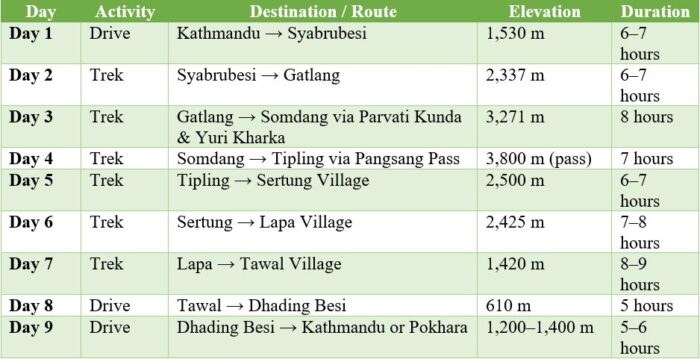
Day 1: A scenic drive from Kathmandu to Syafrubeshi (1530m), 6/7 Hours
Day 2: Trek to Gatlang (2337m) – 6/7 Hours
Day 3: Trek to Somdang via Parvati Kunda and Yuri Kharka (3271m / 8 Hours)
Day 4: Trek to Tipling Village via Pangsang Pass (3800m / 7 Hours)
Day 5: Trek to Sertung Village (2500m) – 6/7 Hours
Day 6: Trek to Lapa Village (2425m, 7/8 Hours)
Day 7: Trek to Tawal Village (1420m, 8/9 Hours)
Day 8: Drive to Dhading Besi (610 m, 5 Hours)
Day 9: Drive to Kathmandu or Pokhara (1200-1400 m, 5/6 Hours)
Our journey of trek to Ruby valley begins with a scenic early morning drive from Kathmandu, marching towards Syafrubeshi in the northeast direction. Our way heads through Nuwakot to Rasuwa. The scenic drive encompasses electrifying Trishuli River, passing through busy and bustlings towns on the way like Kakani town and Trishuli Bazaar, where we will get to see farming and cultivation performed in terraced style of fields.
We will experience the traditional life, rural life and authentically local life of Nepalese villagers. The paved plus up/down roads gradually climbs the path that is situated on the foothills of the Ganesh Himal range, serving our eyes with beautiful views of towering snow-capped mountains. When we reach Syafrubeshi, we will get into a small village where people of Tamang ethnic community reside, and we will check into either a homestay or a teahouse for an overnight stay.
It almost might have taken 6-7 hours of a good drive to reach here. You can explore the locality, the authenticity of the village, the culture and their cuisines. The dinner of the first day is our Nepali authentic Dal Bhat (Rice and Lentils). The ambiance gives you the feeling of serenity, the flowing river adds pleasant music to your ears and the surrounding lets you rest well.
The early morning of the second day, you will be served with a good breakfast. After you take your breakfast, our trek to Ruby valley officially takes off with slow and steady climbs of trails through lush Rhododendron forests and dense Pine trees, sometimes revealing the scenes of cultivated fields and meadows. The route of the trek moves forward through Tamang hamlet where farmers are based on agriculture and animal rearing (livestock farming).
After almost 6 – 7 hours of walk, we reach the village of terraces, Gatlang. It is one of the most photogenic places on the way to Ruby valley. Upon your arrival, you will get treated with traditional styles of Tamang hospitality. You can see the locals performing their cultural dances and traditional rituals wearing their cultural costumes. Gatlang is an abode to an ancient Buddhist monastery, which is a very famous and peaceful spot to meditate and spiritual awakening.
The views of Sunrise and sunset give you real chills as the Ganesh Himal looks golden when the sunrays hit on them. It is a breathtaking experience. Overnight stay in a homestay, where you will enjoy Nepali delicacy and authentic Tibetan butter tea to keep you nice and hot.
The third of Ruby valley trek is often considered as the challenging day of the trek, yet it is the day that offers you with a lot of beautiful views and scenic glimpses. The trail ascends via alpine grasslands and grazing lands. The Himalayan meadows and the pasture is known as Yuri Kharka. You can see many yaks and sheep grazing on the pasture land.
One of the highlight of this trip shows up on this day. Parvati Kunda, the sacred lake in the region is a serene and unblemished high altitude lake. The scenery of the lake looks more vibrant, lively and holy because of the prayer flags defining the religious essence of the sublimity. People often meditate on the shores for inner illumination.
Then, we trek towards Somdang which is located at 3271 meters above the sea level. The total time up to Somdang will be of almost 8 hours. It used to be a mining village in the past days. Locals will say you about the fascinating legends of the village with forbidden mines and rocky landscapes. The cold breeze takes your breathe through a mystical atmosphere below the star-decorated sky. Overnight stay in a simple lodge.
The trek on the fourth day to Tipling village via Pangsang pass is very rewarding. Pangsang pass located at an altitude of 3800 meters is the highest point of the journey. You need to climb the vertical trail, but it is very worthy as you reach the top, your eyes will be revealed with the panoramic views of the ranges of Mount Manaslu, Langtang Himal and Ganesh Himal.
After spending some time at the top and resting well, we come down the trail where lsuh rhododendron forest welcomes us and electrifying waterfalls leads us to the lively village, Tipling. Tipling is a Tamang village. The people here are known for their authentic handricrafts and traditional weaving. Overnight stay at a homestay with lots of story hearing experiences and good dinner.
Trek on the fifth day is not that challenging and not very easy, it is a gentle trekking day. The farmed terraced fields and lush forests will guide you to a very charming village, Sertung. Sertung is a hillside village that showcases the majestic views of surrounding valleys. Farmers in the Sertung village focus in the cultivation of cash crops like potatoes, barley, buckwheat etc.
You can use your spare time to visit the locality and there is a monastery too which gives a good mountain ambience and a vibrant spirituality feel. Overnight stay at a homestay or a lodge in Sertung village. Sertung is located at an altitude of 2500 meters above the sea level.
The trails of sixth day descends via dense forests and bridges over streams. Then, we reach Lapa village which is very popular for its historic legends of Buddhism, ancient Buddhist stupas, monasteries and traditional houses built up of stones. The feeling is serene when you reach Lapa village, the tranquil atmosphere, and religious definition continuously flowing through the prayer wheels placed on either sides of the pathways. Listen to the sublime chants of prayers from monks and nuns of the Lapa monastery, visit the Lapa monastery and overnight stay at a homestay in Lapa. The food is extremely fresh, organic and very delicious. You can the rest of the day walking up experiencing the locality too.
The seventh day is the final trekking day of the Ruby valley trek. The trail we follow on this day is mostly downhill and a bit long. The subtropical forests come on the way, we cross that through terraced farmed lands and arrive to our destination for today, Tawal village. It almost takes 8-9 hours of trek to reach here.
Tawal village is the Gurung village that is situated on the laps of verdant hills located at an altitude of 1420 meters serving our eyes the picturesque and stunning view of agrarian village livelihood. The locals are very friendly, you can watch and observe their day to day activities.
You will have your farewell dinner with the guide and the porters this evening. Overnight stay at the lodge/hotel at Tawal village.
After you take your breakfast, we will drive you from Tawal village to Dhading besi in a shared jeep, which is located at 610 meters above the sea level. Dhading town has now been a busy and bustling town of the district with modern amenities. The route to Dhading from Tawal is very scenic as it follows way by the shores of Budhi Gandaki River, very electrifying. After the arrival and check in at a good hotel, you can take a hot shower, explore the locality, local market etc. or just rest throughout the rest of the day. Overnight stay at the hotel.
The ninth day will officially mark end to your journey of Ruby valley trek. From Dhading besi you get two option. Either you move back to Kathmandu, or extend the trip for next 3-4 days by visiting Pokhara, famous tourist destination in the country. It takes around 2-3 hours to get back to Kathmandu, and about 5-6 hours of drive to Pokhara from Dhading besi.
If you get back to Kathmandu, you can utilize the remaining time of the day shopping the gifts you take back home, or do whatever you like. We can assist you in shopping as well or you can move freely anywhere in the city on your own and get ready for your departure. Overnight stay at the hotel in Kathmandu.
(Note: Itinerary can be customized if you extend the trip to Pokhara.)
The realities of this route, told straight, so nothing surprises you later.
At 3,800m, Pangsang Pass sits below the altitude where serious AMS risk typically kicks in, and the operator doesn’t build in a dedicated acclimatization day for that reason. The real physical challenge here is daily walking time, not altitude — expect 6–9 hours a day, with Day 3 (to Somdang) and Day 7 (to Tawal, 8–9 hours) as the longest stretches, so pace yourself on those days specifically.
Unlike higher Himalayan treks, there’s no mountain-airstrip flight risk here at all — the trip starts with a 6–7 hour drive from Kathmandu to Syafrubesi and ends with a drive from Dhading Besi back to Kathmandu or on to Pokhara. Per the operator, this route can’t be swapped for a flight (helicopter charter aside), so build your schedule around road time rather than weather-delay buffers.
You’ll stay in a mix of homestays and simple lodges in Syafrubesi, Gatlang, Somdang, Tipling, Sertung, Lapa, and Tawal — genuinely warm hospitality, but basic facilities, with charging, hot showers, and Wi-Fi typically costing extra and becoming less reliable the further you get from Syafrubesi. A down jacket and sleeping bag are provided as part of the package and should be returned at the end.
Travel and rescue insurance is explicitly excluded from the trip cost. Given the modest 3,800m high point, standard trekking-cover travel insurance is generally sufficient rather than a high-altitude/helicopter-specific policy but it’s still worth arranging before you arrive, since rescue or evacuation costs aren’t covered by the package either.
An English-speaking, government-licensed guide (plus an assistant guide for groups of 10) and porter service (roughly one porter per two trekkers) are built into the package, along with Langtang National Park permit and TIMS card paperwork. Given how lightly-trafficked and remote this route is compared to Nepal’s bigger-name treks, the guide’s local knowledge and homestay connections add real value beyond just navigation.
The ideal seasons for Ruby Valley trek are:
Spring Season: The time of March to May have clean and tranquil weather, the weather remains stable most of this season with forests blooming with national flower rhododendrons.
Autumn Season: The months from September to November do have clear blue skies, the weather conditions remain stable with best visibility of scenes and the whole scenery looks so majestic.
Monsoon season: We suggest you to not travel or just avoid this season. The time of June to August, it remains very rainy, the trails are very slippery and muddy. Leeches trouble your walking.
Winter season: We also suggest you to not travel or just avoid this season. The time of December to February, the weather remains extreme cold, snowy everywhere, the trails are very slippery due to snow.
If you ever wish to book a package of Ruby valley trek, Info Nepal Tours and Treks has brought you with exciting offerings and services. For all trekkers and travelers who are very excited to visit and explore the sublimity of the Ruby Valley, we are for your service. In the package, we provide a complete range of services you will need and want, assuring your good journey to be very smoothly operated from the starting point to the ending point, beginning with an airport arrival pick-up, or managing permits, transportations, assist in various shopping or anything to your departure drop-off, in our own style of Nepali hospitality and authentic tradition.
Commence your fantastic journey with a lot of enthralling experiences on the way, you can either drop us an email or give us a quick call at (+977) 9841936940 or Whatsapp the same number or contact@intrekking.com. The specialty of our Info Nepal Tours and Treks team is based on responding quickly to the interested trekkers and travelers.
We’ll work closely with you to tailor our services and make sure everything is customized to meet your specific needs. Our goal is to turn your vision into reality and ensure that your adventure is everything you’ve dreamed of and more. We will serve with every ability we do possess, either you are a beginner trekker or a seasoned trekker, we got you covered.
If you have any questions before making your decision, don’t hesitate to reach out. Info Nepal’s supportive staff is always available to answer queries, offer advice, and provide any additional information you might need.
Ruby valley is located in Dhading and Rasuwa district of Nepal. This scenic valley falls in between Langtang region and Manaslu region.
It depends upon the route you chose and your preference, but it takes 9 complete days to complete the Ruby valley trek.
Spring Season: The time of March to May have clean and tranquil weather, the weather remains stable most of this season with forests full of national flower rhododendrons.
Autumn Season: The months from September to November do have clear blue skies, the weather conditions remain stable with best visibility of scenes and the whole scenery looks very majestic.
Ruby Valley trek is known as neither difficult nor easy trek. One or two days count as more challenging days, but other days are easy and smooth.
Of course, Ruby Valley trek is known as neither difficult nor easy trek. One or two days count as more challenging days, but other days are easy and smooth. Any beginners with good physical health can complete the trek.
The highest point of the trek is Pangsang Pass located at an altitude of 3,800 meters (12,467 ft) above the sea level.
Ruby valley trek and its trails is not that crowded, as people choose this destination as the alternative trek. Being less popular, it is too peaceful and naturally preserved.
Ruby valley trek starts with a scenic drive from Kathmandu to Syafrubesi on the first day, and ends with a drive from Dhading besi to either Kathmandu or Pokhara on the ninth day.
We should hike 6 to 8 hours on an average, per day.
The highest point of the trek being Pangsang Pass located at an altitude of 3,800 meters (12,467 ft) above the sea level, which is not considered as a challenging altitude. Hence, there will be no any acclimatization days, but you can adapt to the altitude with gradual ascents.
Yes. There are significant villages to visit on the trek like Gatlang, Somdang, Tipling, Sertung, Lapa, and Tawal. We will be staying each night in each of the villages too.
Parvati Kunda is significant because it is the holy lake at high altitude considered very sacred. People often meditate by the shores of the lake for spiritual awakening and inner illumination.
Yes. Why not. You can customize the itinerary as per your wants and necessity. You can prefer to extend the trek days, extend the trip to Pokhara and other destinations. The cost also changes with the change in the itinerary.
The ethnic group that reside in Ruby valley region are Gurungs and Tamangs. They are the inhabitants of this region.
You get the accommodation facilities in simple Homestays and teahouses during the trek. They facilitate you with your every basic needs. Homestays and Teahouses in every overnight stay has great hospitality, basic furnished rooms and traditional decor.
Meal, three times a day as included in the itinerary will be served. The food includes Tibetan bread, curry, soup, potatoes, and spicy pickles with garlic, vegetables, mountain fruits, butter tea, lentils and rice.
If the trekkers do hold any dietary restrictions like being vegan, vegetarian, gluten free or allergen to lactose, this thing is very important for trekkers to give detailed information to trek agency or the guide or the cook prior.
Yes. Sleeping bags are highly recommended. You can get rented sleeping bags from the city / Kathmandu.
Yes. Trekking poles are highly recommended as they reduce the strain and stress on the knee/feet during ascents and descents.
We suggest the type of shores that are available as trekking shoes or hiking boots, or shoes that grip well. It is very essential to get a shoes of good quality, cushion sole and grip.
No. We cannot swipe the drive with the option of flying as there are no any direct flights from Kathmandu to the region. You can use helicopter though it is more expensive.
You will get an experienced, English-speaking and government-licensed trek Guide and assistant trek guide (10 trekkers: 1 assistant guide).
You will get porter service in the ratio of (1 trekker: 1 porter & 2 trekkers: also 1 porter).
We will require Langtang National Park permit and TIMS card is needed. That responsibility is on our (Trek operator) head.
The trend of eco-tourism has also been started in the Ruby valley region, as plastic bans has been imposed.


4.9 from 90+ Google reviews
Our overall Google Business rating Langtang  Langtang
 Langtang
Trip: Ruby Valley Trek
Operator: Info Nepal Tours and Treks, Thamel, Kathmandu
Region: Langtang Region, Nepal
Duration: 8 days
Maximum altitude: 3,800 m
Difficulty: Easy
Group size: 1-10 people
Best season: March-May : September-November
Summary: A quiet trek through the Ganesh Himal region west of Langtang, crossing Gurung and Tamang villages, rhododendron forests and the Pangsang Pass between Gatlang and Tipling, suiting trekkers wanting a less-travelled cultural route.
Overview: Overview Ruby Valley is one of Nepal’s natural wonders blessed with marvelous geography, majestic views and great culture. Situated within the laps of great Ganesh Himal, the Ruby Valley trek is still a favorable choice for many trekkers and travelers as it offers cultural enrichment, breathtaking sceneries, and enthralling adventure experience. As the trail progresses, we explore the way through…
Itinerary outline: Day 1 A scenic drive from Kathmandu to Syafrubeshi (1530m), 6/7 Hours; Day 2 Trek to Gatlang (2337m) – 6/7 Hours; Day 3 Trek to Somdang via Parvati Kunda and Yuri Kharka (3271m / 8 Hours); Day 4 Trek to Tipling Village via Pangsang Pass (3800m / 7 Hours); Day 5 Trek to Sertung Village (2500m) – 6/7 Hours; Day 6 Trek to Lapa Village (2425m, 7/8 Hours); Day 7–end
Includes: Airport arrival picks up and drops off by the private vehicle, Three-time Meal during the trek as per the itinerary (Breakfast, Lunch and Dinner), Ground transportation covered on a cozy private vehicle as instructed by the itinerary, City tour in Kathmandu by a private vehicle, An experienced, English-speaking and government-licensed trek Guide/Leader and assistant trek leader (10 trekkers: 1 assistant guide), Porter service (2 trekkers: 1 porter), Staff costs including their salary, insurance, equipment, food and accommodation., Rented down jacket and sleeping bag (to be returned after trip completion), All necessary paperwork, documentations, trekking permits.
Not included: Nepalese visa fee, Excess baggage charge(s), Private transportation except what is mentioned in the 'service includes' section, Extra night accommodation in Kathmandu and Pokhara because of early arrival, late departure, early return from mountain (due to any reason like natural disaster and your own problems) than the scheduled itinerary Lunch and evening meals in Kathmandu (and also in the case of early return from the mountain than the scheduled itinerary), Travel and rescue insurance, Trekking equipments
Contact: +977 9841936940 · contact@intrekking.com · WhatsApp
